

12S pack on a 4–8S board
Symptom: the board never comes up, or the regulator fails on first power-up.
Fix: order the 12S variant. Voltage class is decided at checkout, not on the bench.
A spec sheet only tells you half the story — the other half is whether the parts actually fit together. This hub cross-references fpv drone components by mount pattern, voltage window, BEC headroom and port budget, using the Argus H743 PRO as the reference board throughout. Run the five checks, read the matrix, and when you are ready to compare fpv parts for sale, you will already know which combination survives the build.
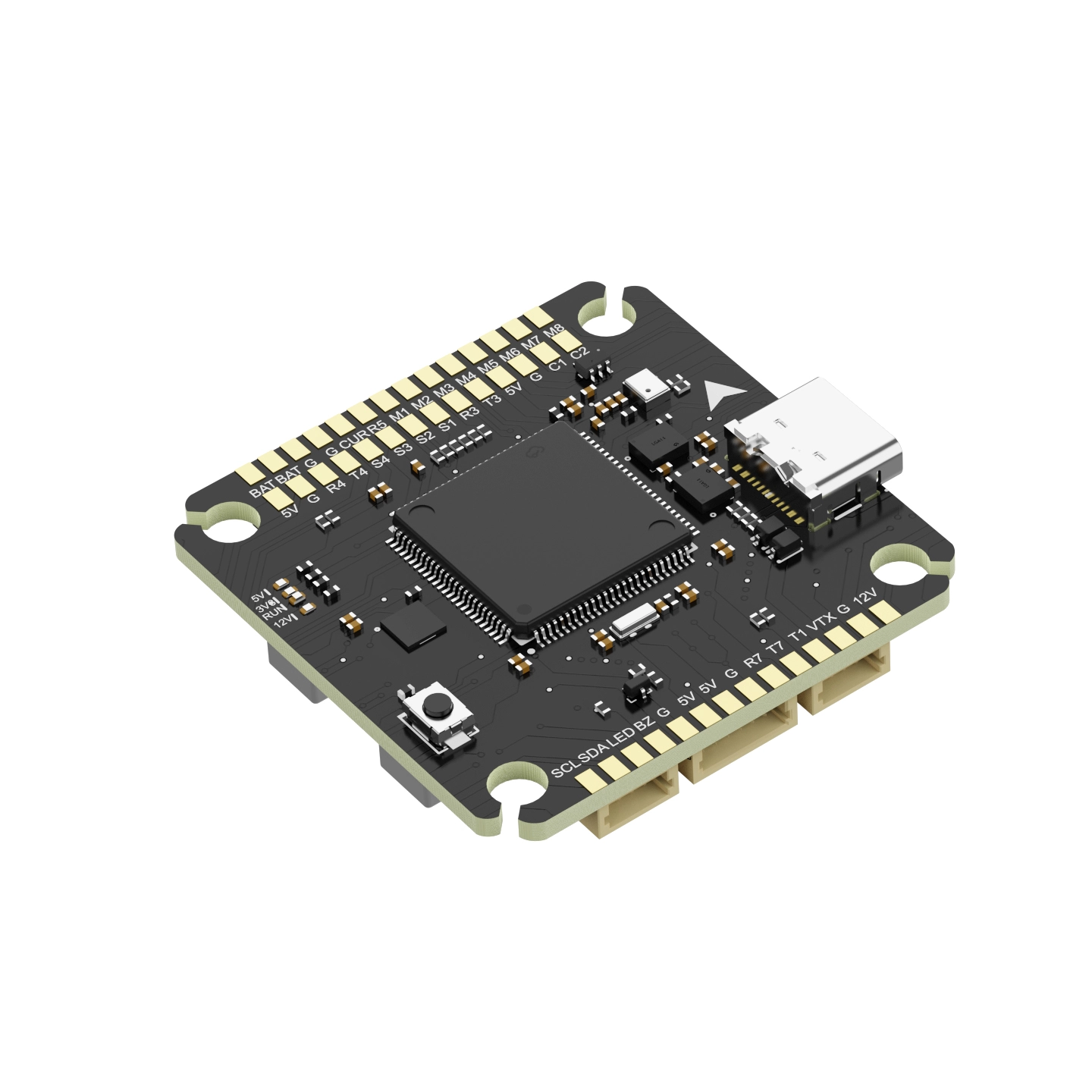
Checks are not equal. Each one below is harder to undo than the one after it, so run them in this order — failing an early check makes the later ones irrelevant.

The H743 PRO carries seven UARTs, dual BEC rails, OSD, a 16M blackbox and an onboard current sensor on a 38 × 38 mm board.
The H743 PRO is listed as 4–8S LiPo / 12S, and the variant selector offers separate 4–8S and 12S options. Order the variant that matches your packs — voltage class is the only check you cannot fix with wiring or firmware.
30.5 × 30.5 mm holes for M3 hardware. If your frame or ESC stack is drilled at 25.5 × 25.5, no adapter turns that into a clean build — change the stack, not the frame.
The flight controller sends signal; it does not carry motor current. Size your ESC's continuous rating against the motors' full-throttle draw before you commit to a power system.
Seven UARTs sounds generous until you count receiver, GPS, VTX or HD air unit, telemetry, gimbal control and camera control. Write the list down before you buy.
Dual or single ICM42688P, plus the DPS368 barometer. This is the only check you can revisit later without desoldering anything — so decide it after the four hard constraints.
One column is the board's own published specification. The other is the rule you apply to everything you bolt to it. If a row fails, stop — the rest of the build does not matter yet.
| Check | H743 PRO specification | Rule for the rest of the build |
|---|---|---|
| Mount pattern | 30.5 × 30.5 mm / M3; board 38 × 38 × 8 mm at 9 g | Frame and ESC stack must be drilled 30.5 × 30.5 for M3. A 25.5 × 25.5 stack fails this row. |
| Voltage class | Input listed as 4–8S LiPo / 12S, with separate 4–8S and 12S variant options | Order the variant that matches your packs. Never bridge a voltage class with adapters. |
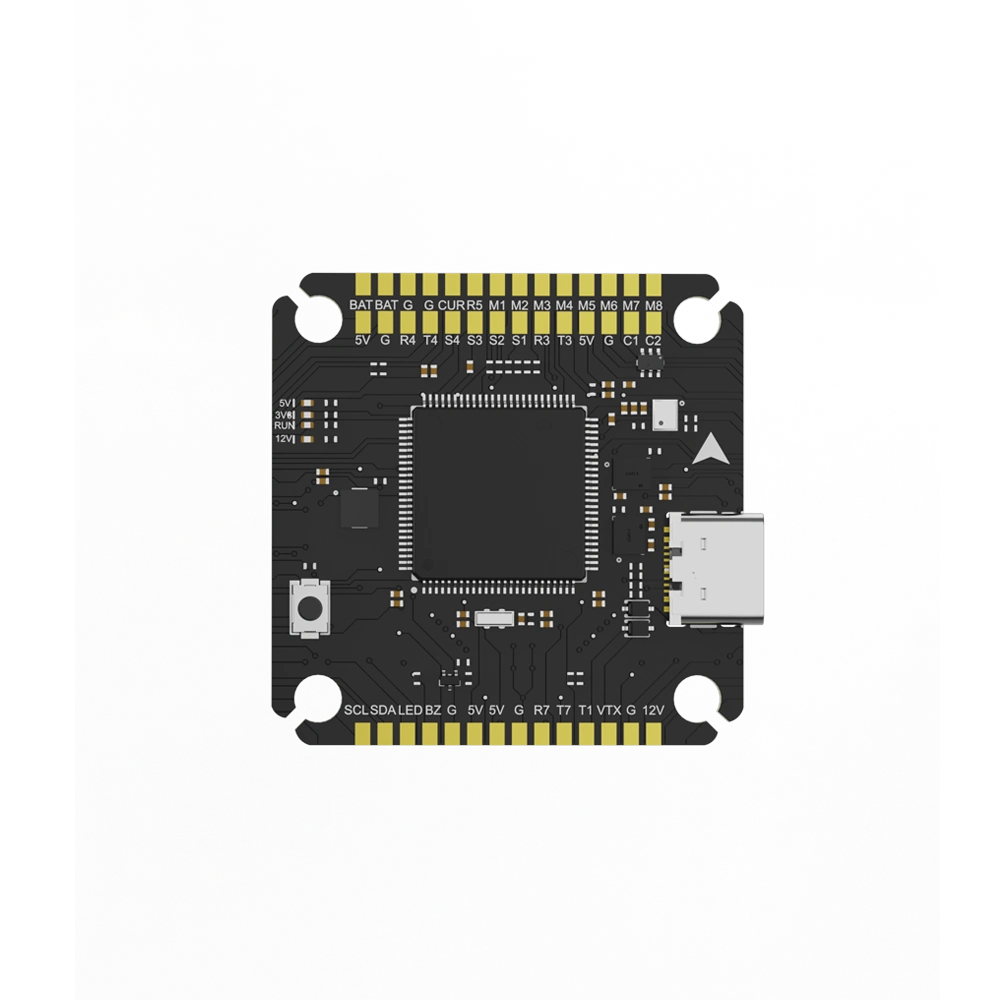
| Motor outputs | M1–M8 — eight motors supported | A 4-in-1 ESC uses M1–M4. An X8 coaxial frame needs all eight signal lines run and terminated. |
| ESC current | Handled by the ESC, not the flight controller | Size continuous ESC amps to the motors at full throttle, plus margin for prop loading. |
| BEC rails | 5V / 2.5A and 12V / 2A | Sum 5V and 12V loads separately. Add an external BEC when either rail runs out of headroom. |
| Ports | 7 UARTs, OSD supported, Type-C USB | Count every device that needs a data port, not just the ones you plan to fly with today. |
| Sensing and logging | Dual or single ICM42688P, DPS368 barometer, onboard current sensor, 16M blackbox flash | Current sensing and logging need no extra parts. Gyro variant is decided at checkout. |
| Processing | STM32H743 at 480 MHz, plug-and-play connections for most devices | Confirm your firmware target supports the H743 before you flash anything. |
The page rates the board for 5–10 inch freestyle, long-range, heavy-load and cinematic airframes, so every row above assumes a full-size stack rather than a micro build.

M1–M8 outputs let the same board run a four-motor quad or an eight-motor coaxial airframe.
Two rails, two separate budgets. The 5V rail feeds logic and sensors; the 12V rail feeds video and lighting. Add them together and you will overestimate what you can run.

Silicone 10P, 8P and 4P leads plus a GPS cable are included, so most devices plug in without soldering.
| Rail | Rated output | Planning allowance | Devices to count |
|---|---|---|---|
| 5V | 2.5 A / 2500 mA | about 1750 mA continuous | Receiver, GPS module, camera, LED strip, gimbal controller, buzzer |
| 12V | 2.0 A / 2000 mA | about 1400 mA continuous | VTX or HD air unit, camera feed, lighting |
The planning allowance leaves roughly 30% of each rail unused so the regulator keeps thermal headroom on long flights. Check each device's rated draw, add them per rail, and move the heaviest load to an external BEC the moment your total passes the allowance.
A single device moved off the 5V rail often rescues an entire build: receiver dropouts and camera flicker on throttle punch are usually a rail that is fully loaded, not a broken board.
This is a planning grid, not a compatibility verdict. Nothing here fails — you just run out of ports, and the last device on your list is the one that gets dropped.
| Port | 5" freestyle | 7–10" long-range | Cinewhoop | X8 heavy-lift | Inspection / UAV |
|---|---|---|---|---|---|
| UART 1 | RX | RX | RX | RX | RX |
| UART 2 | — | GPS | GPS | GPS | GPS |
| UART 3 | VTX / HD air unit | VTX / HD air unit | HD air unit (primary) | VTX / HD air unit | Telemetry radio |
| UART 4 | — | Telemetry | HD air unit (secondary) | Telemetry | Gimbal control |
| UART 5 | — | Spare | Spare | Gimbal control | Payload / companion link |
| UART 6 | — | Spare | Spare | Spare | Spare |
| UART 7 | Spare | Spare | Spare | Spare | Spare |
| Ports used | 2 of 7 | 5 of 7 | 4 of 7 | 6 of 7 | 6 of 7 |
The cinewhoop is the tight case: an HD air unit that needs a primary and a secondary port plus a GPS leaves almost nothing over, and gimbal control never finds a home. Decide which device you can fly without before checkout — seven ports is the ceiling and no firmware update adds an eighth.
Both gyro configurations are offered on the same board at the same mount pattern, so this decision never breaks a build. It changes how much isolation work you have to do yourself.

The DPS368 barometer is what makes altitude hold and stable hovering available on this board.
DPS368 barometer: the published benefit is accurate altitude hold and stable hovering. That matters for low-altitude inspection work and for long-range flights where you hold an altitude for minutes at a time. For pure line-of-sight freestyle it changes very little — but it costs nothing to have, and it is on the board already.
Every other module on this page describes what works. This one describes the failure modes that come back as returns — and the fix that costs the least to apply.
Symptom: the board never comes up, or the regulator fails on first power-up.
Fix: order the 12S variant. Voltage class is decided at checkout, not on the bench.
Symptom: the board will not seat, or it seats on one corner and cracks a silicone standoff.
Fix: match the stack to the board, then match the frame to the stack.
Symptom: receiver dropouts and camera flicker exactly on throttle punch.
Fix: move the heaviest 5V device onto an external BEC and re-sum the rail.
Symptom: GPS and gimbal are both wired and neither responds reliably.
Fix: allocate on paper against the seven-port grid before the soldering iron comes out.
Symptom: the upper motor set gets no signal, or only two of four arms spin.
Fix: use an ESC with eight outputs, or two ESCs, and run every line from M1–M8.
Symptom: altitude hold drifts and the quad wanders instead of holding a height.
Fix: keep the DPS368 port clear of foam, tape and conformal coating.
Pick the airframe you are actually building. Each row names the one check that rules out the wrong purchase, and the configuration to start from.
| Your build | Deciding check | Why it decides everything | Starting configuration |
|---|---|---|---|
| 5" freestyle | Mount pattern | Most 5" frames are drilled for a standard stack; a mismatch ends the build before electronics matter. | 4–8S variant, single or dual ICM42688P |
| 7–10" long-range | Voltage class and BEC headroom | Higher cell counts plus GPS and a long-range VTX load both rails at once. | Match your pack variant, dual ICM42688P, DPS368 altitude hold |
| Cinewhoop | Port budget | An HD air unit claims more than one port, and a GPS takes another. | 7 UARTs mapped on paper before wiring |
| X8 coaxial heavy-lift | Motor outputs and current headroom | Eight motors need eight signal lines and an ESC that can carry the combined load. | M1–M8 in use, dual ICM42688P for vibration tolerance |
| Inspection / UAV | Sensor set and logging | Altitude hold and post-flight data matter more than weight or simplicity. | Dual ICM42688P, DPS368, 16M blackbox, onboard current sensor |
All five scenarios are covered by the same 30.5 × 30.5 mm board rated for 5–10 inch freestyle, long-range, heavy-load and cinematic airframes — the difference is which check you run first, not which board you buy.
Send us your airframe list, voltage class and port plan and we will confirm the right variant and quantity mix before anything ships. In-stock boards go out by DHL in 3–7 days, and shipping is free on orders over $200 (FPV not included).
Keep adjacent product options together for a faster catalog comparison.

Argus Mini 60A/H743 STACK 3-6s,STACK,Small size FPV / AM 32bit /42688
View product
The VERTEX 5 is our brand-new fully enclosed 5-inch DeadCat DC Squished X cinematic freestyle platform, tailor-made for aerial content creators and advanced FPV pilots.
View product
Track racing and freestyle FPV demand ultra-light airframe, explosive power and reliable video transmission at the same time. Most pilots and overseas distributors struggle to find a complete BNF drone that balances cost, durability and performance.
View product30.5 by 30.5 mm with M3 holes. the frame and ESC stack must be drilled to the same pattern, and a 25.5 by 25.5 stack fails that row.
the input is listed as 4 to 8S LiPo or 12S, with separate 4 to 8S and 12S variants. order the variant that matches your packs and never bridge a voltage class with adapters.
M1 to M8, so eight motors are supported. a 4-in-1 ESC uses M1 to M4, while an X8 coaxial frame needs all eight signal lines run and terminated.
38 by 38 by 8 mm at 9 g. the board size matters when the frame stack has to clear the camera cage or the VTX.
it does not, because current is handled by the ESC rather than the flight controller. that is why the page keeps motor count and voltage class as separate rows.
the mount pattern, the voltage class, the number of motors, the ESC stack height and the port allocation, since the page cross-references components by mount rather than by brand.


